Six Tips to Uncover Female Ancestors
The a3Genealogy Research teams delight in tracing female ancestors who paved the roads for us. Were they
housewives and mothers, were they teachers or schoolmarms, were they wet nurses
or midwives, were they the maids, the slaves, the cooks? Did they attend
suffrage movements, or civil rights movements? Were the abolitionists,
prohibitionists, or fighting for unwed mothers? Our female ancestors influenced
change. When I felt disempowered at work or at home, my mother would proclaim “the
woman was the neck, that turned the head.”
When looking for women ancestors, though, it can be
challenging. The majority changed their names, and their identity through marriage.
But remember all did not! Was your female ancestor one of the married stage performers
who proudly held their maiden name?
Let us share tips to researching your female ancestors
- Women Organizations.
 |
The National Association of Colored Women’s Club, Inc.
founded Washington, D.C. in July 1896 |
These groups may have been for ethnic socializing, divided by class, or designed
to promote “worldliness” like an education curriculum for women on par with
men. They were for women to vent, mingle, chart out their children’s social
circle, and to influence politics often through their husbands.
2. Local community and political activities.
Be sure to plot out your female
ancestor’s timeframe using community and political issues. It’s overwhelming
how many women groups met in “secret” to fight for their agenda. These
groups may have been an ethnic groups, divided by class, promoting “worldliness”
like an education curriculum for women on par with men.
3. Women School Records.
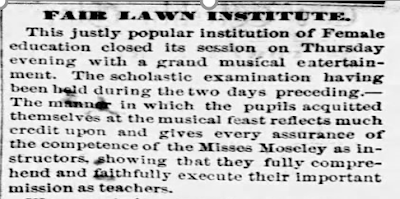 |
| The Clarion-Ledger
(Jackson, Mississippi) 7 Jul 1870, pg.1 |
Men didn’t seem to bulk at women reading the Bible and taking darning and sewing classes. But often the line was drawn at philosophical, maths, and “brainy knowledge.” Although 1800 education was seen as a way of making women better wives and mothers, there were some progressives that moved the educational rod to encourage education for women to be transformative. I’m a proud alumna of Stephens College, 1333, Columbia MO, a women’s college. By the way, they have an amazing archive filled with history. During WWII, they housed and educated orphan teenagers from across the nation - children of war veterans.
4. Church Minutes / Records.
Have you read these
gossip-filled accounts of the congregants?
Oh my…we have found records from Quakers, the women, who held important
positions in conducting the Underground Railroad, to the public shaming of
those in infidelity in the German churches of Missouri. Contrary to common
belief, these records are not just filled with sacraments dates.
5. Immigrant Societies.
Women
were activists. They helped with the
immigrant societies. This was not just in port cities, but inland also. They
were active in the Volga – Germans, Irish, German, Italian, etc. communities. Again, scour the society books for familiar
names. Review newspaper articles on the local immigrant societies. Discover
which roles the women played. They were like matchmakers of old. They connected wives and children to housing.
They were thanked for holiday meals and performances. They fought for the poor
and admonished “the wicked!”
6. Delayed birth records
of the community.
At a brick wall? Try
reviewing early birth records, especially delayed birth records of the
community. We have uncovered over a half dozen female ancestors for clients as
they were midwives. Yes, you have to conduct
the research, but if Louise was her name, be sure to uncover "Louise" named midwives on birth and delayed birth records. Delayed birth records come with affidavits that may assist in identifying your “Louise.”
Other article:
Genealogists Can Reconstruct the Lives of Female Ancestors
The Daily Herald, Mar 26, 1998 , pg 39
Fewer Records Available for Women Ancestors
Victoria Advocate, Apr 06, 2003 ·Page 39
Be Historically Correct
Kathleen Brandt
a3genealogy.com
Accurate Accessible Answers