Sunday, November 20, 2022

DNA - $36.00 That's a Wonderful Friday!

The Black Friday DNA Sale
Expires 20 Nov 2022.  

You know you want to know if that Weird Uncle is really family.  Or, are you the Weird Uncle? Visit here: MyHeritage DNA

Remember, even if other family has tested on ancestry.com, we can connect you all on MyHeritage DNA. 

Have questions? Ask Kathleen@a3genealogy.com

Monday, November 14, 2022

Records for Women Serving in WWI??


From the Mail Bag

Ellen, 
We love our women ancestors. They were proactive in war efforts and served when they could. Keep in mind that during WWI women were barred from voting in the USA; and, could not serve in military combat roles. However, they did volunteer toward the war efforts and provided support on the front lines: nurses, translators, dieticians, and even drivers. We must give them credit for paving the way for today's women to think bold and big. Be sure to enjoy the video.

Clues
You provided two great clues when you included this nuggets: 1) May be Red Cross 2)  her service was "close to the end of the war. We know the dietitians began serving with the Army in 1917. 3) she served at "Camp" Dix. 

We hope you saw this article which included at least one new dietitian, Miss Marion Peck:
 "https://www.newspapers.com/image/430650251/

This article proved the following: 
1) the word "dietitian" in this research must be done with its popular misspelling "dietician" or use a wildcard "dieti?ian"
2) in your search efforts remember dietetics vs dietitian may be used (i.e. hospital dietetics)
3) although we love saying Fort Dix, we need to search it as "Camp Dix" especially for WWI research. The name change was 1947.
4) Camp Dix had a double issue - the War and the
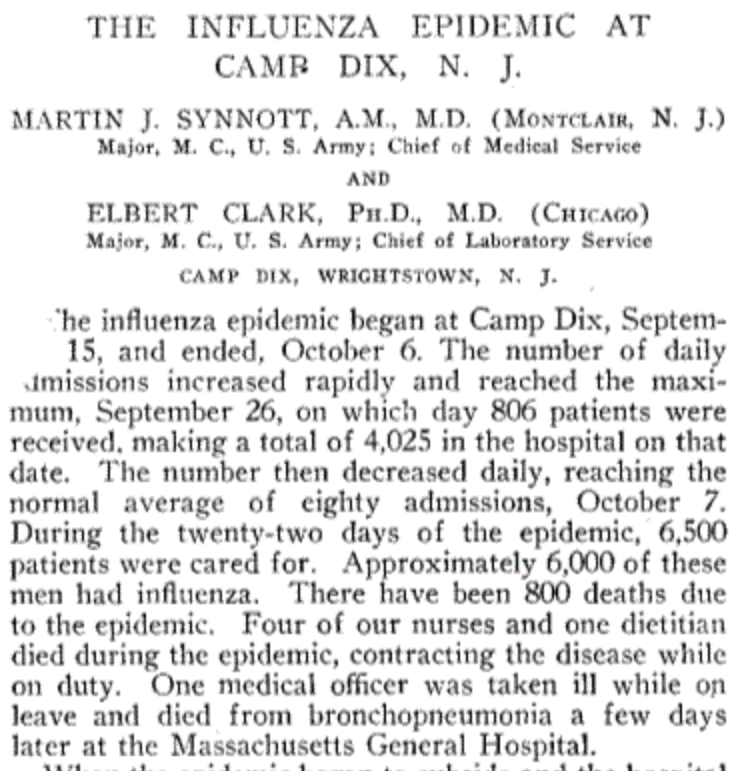
1918 Influenza Epidemic.  Did you know one dietitian died after contracting the disease while on duty in 1918?[i].

[i]  The Influenza Epidemic at Camp Dix, NJ, 30 Nov 1918; Jama Network

The Basic Research
You didn't provide a name for your ancestor, or her location, so I'm assuming your grandmother was in America, not England or Canada, overseas, etc. With that in mind, let's also assume you already checked the following:

Still a Brickwall?
The Army Nurse Corps definitely hand women dieticians. As many of these dietitians traveled overseas, we are able to uncover passenger lists. The following list found, on Fold3, is actually quite extensive.
Let's also turn to academic papers and professional journals knowing now that female WWI dietitians must also be researched within the Army Nurse Corps collections. Here's just one American Journal of Nursing that list those who served in the Army Nurse Corps at Camp Dix March 1918[2] 
Adlin M. Wagner and Loretta M. Pratt, Olga Sletten, General Hospital No. 26, Fort Des Moines, Iowa. Ethel M. Collins, Pearlena V. Soles, Mary E. Spare, Ellen Brady, Amy Reed, Kathleen E. Murphy, Edna L. Bailey, Matilda Blackberg, Eleanor J. Menah, Ruth Ardron, Marie R. McManus, Alice N. Hemingway, Helen Canty, Sadie E. Houston, Agnes C. Peterson, Alva Tomlinson, Marie S. Fordham, Regina H. Conroy, Edna Cubbi- son, Elsie M. Botdorf, Mildred K. Magee, Agnes S. Dalton, Mary M. Bittner, Margretta Hibert, Edith MacMahan, Lulu A. Brennan, Isabella J. H. Aitken, Grace I. Richards, to U. S. Army Base Hospital, Camp Dix, N. J

[2] Nursing News and Announcements, The American Journal of Nursing, Dec 1918, Vol 19. No 3, pg 206-252, Lippincott Williams & Wilkins; : https://www.jstor.org/stable/3406207

Digging Deeper
Well, this may not be a brickwall, but a brick skyscraper! Here are a few other places to peruse:

  1. Government Civilian PersonnelIs it possible your grandmother served as a civilian for the military? Civilian records are at the National Personnel Record Center in St. Louis.  Here is a link: https://www.archives.gov/st-louis/opf.  
  2. Archives.gov. Here is another place you can get started with the Records of the American National Red Cross, 1881-2008, search term: Red Cross Dietitian:  https://catalog.archives.gov/search?q=red%20cross%20dietitian
  3. Local Newspapers. Many of these honored Red Cross assignments were posted in local newspapers: 

Republic County Democrat, Belleville, KS. 

Suggested Reading:

For More on Women Serving in WWI
Video Provided by WWI Museum, Smithsonian, KCMO


Kathleen Brandt
Be Historically Correct
a3genealogy.com
Accurate Accessible Answers
a3genealogy@gmail.com

Monday, November 7, 2022

Ancestry DNA November 2022 Holiday Sale


Offer ends 23 Nov 2022

Remember all proceeds, using this link, are donated to Tracing Ancestors.org: a 501c3 (Not-for-profit) dedicated to serving women, schools & underserved Communities


Kathleen Brandt 
         
 Website: a3Genealogy 
accurate accessible answers
P.O. Box 414640
Kansas City, MO.  64141

816-729-5995; fax: 816-817-2146 


Monday, October 10, 2022

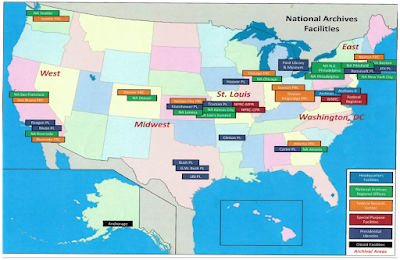
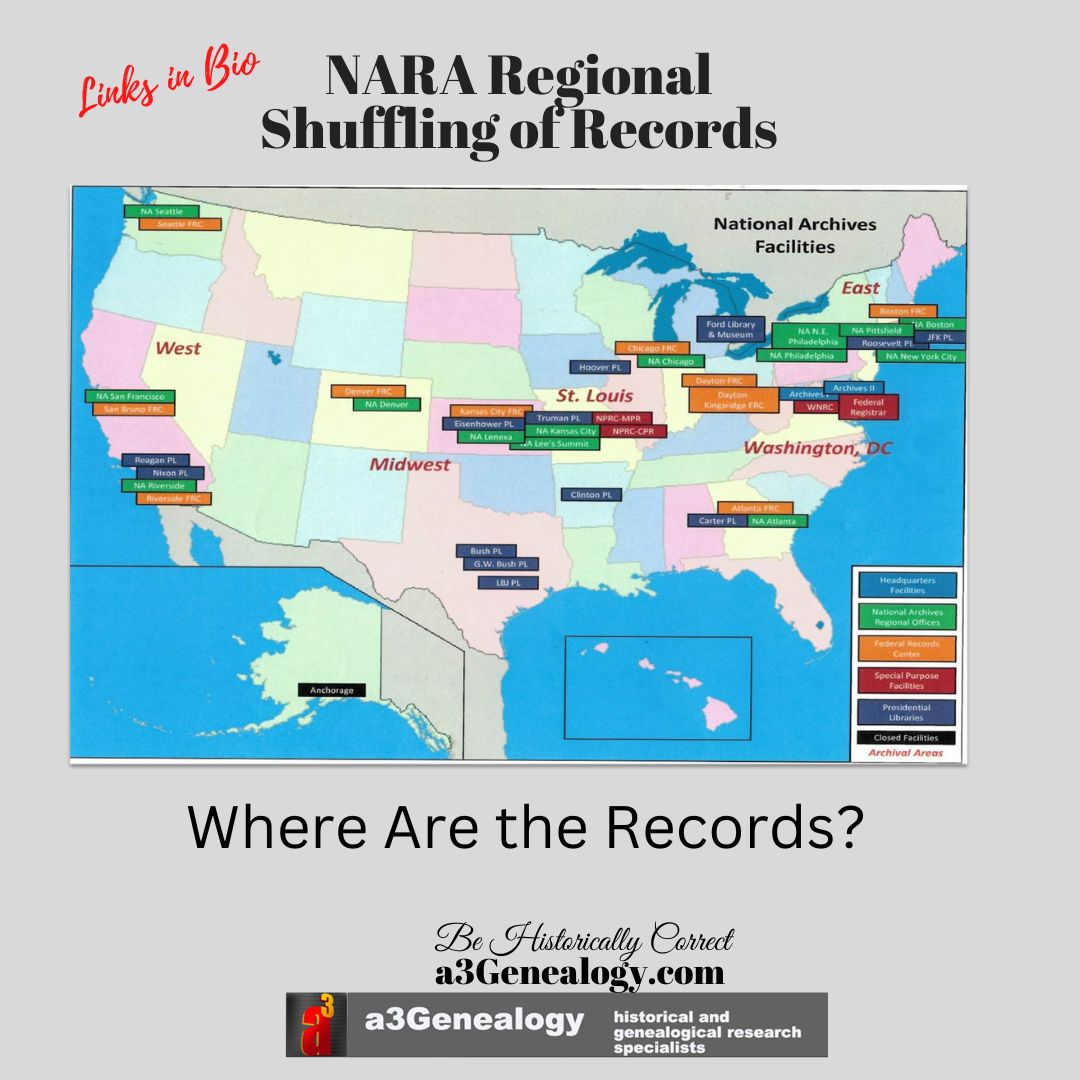
NARA Regional Shuffling of Records


Genealogists and historical researchers know that there are National Archives Branches across America.  


Whereas Kansas City is the repository for North Dakota, South Dakota, Nebraska, Kansas, Minnesota, Iowa, and Missouri; Fort Worth is the repository (well, they were), for Arkansas, Oklahoma, Louisiana, and Texas.  

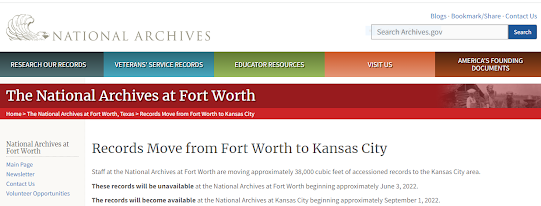
Many of us missed this announcement, however, NARA - Ft. Worth Regional is sending some of its holdings to Kansas City.  this includes the following:
If you aren't sure how Court Records, or Bankruptcy Records can help with you genealogical search, read here: 

Another fine way to prove KC is the center of all things!

Be Historically Correct  

Kathleen Brandt
a3genealogy.com
Accurate Accessible Answers
a3genealogy@gmail.com  


Saturday, October 1, 2022

October Family History Month


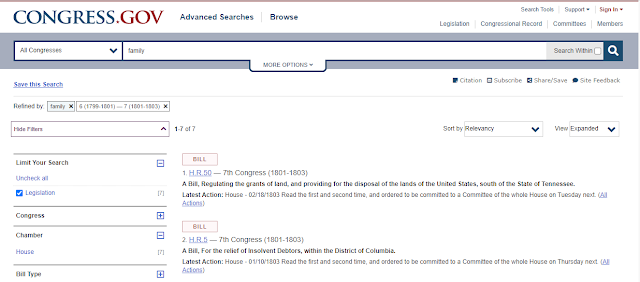
For research tips visit: Congress.Gov, The Forgotten Resource

October Family History Month since 2001

IN THE SENATE OF THE UNITED STATES
                           September 12, 2001
    Mr. Hatch (for himself, Mr. Reid, Mr. Inhofe, Mr. Thurmond, Mr. 
 Bennett, Mr. Dodd, Mr. Stevens, Mr. Craig, Mr. Grassley, Mr. Cleland, 
Mr. Hutchinson, Mr. Inouye, Mr. DeWine, Mr. Campbell, Mrs. Clinton, Mr. 
Nelson of Nebraska, Mr. Leahy, Mr. Conrad, Mr. Frist, Mr. Rockefeller, 
 Mr. Jeffords, Mr. Baucus, Mr. Sessions, Mr. Helms, Mr. Bingaman, Mr. 
   Bunning, Mr. Miller, Mr. Murkowski, Mr. Nickles, Mr. Cochran, Mr. 
 Domenici, Mr. Allen, Mr. Smith of Oregon, Mr. Wyden, Mrs. Feinstein, 
Mr. Daschle, Mr. Fitzgerald, Ms. Snowe, Ms. Collins, Mr. Wellstone, Mr. 
   Kerry, Mr. Dorgan, Ms. Cantwell, Ms. Stabenow, Mr. Kennedy, Mrs. 
   Lincoln, Mr. Specter, Mr. Biden, Mr. Brownback, Mr. Roberts, Mr. 
  Allard, Mr. Bayh, Mr. Byrd, Mr. Nelson of Florida, Mr. Schumer, Mr. 
Hollings, Mr. Santorum, Mrs. Hutchison, Mr. Corzine, Mr. Thompson, Mr. 
 Lugar, Mr. Voinovich, Mr. McConnell, Mr. Lott, Mr. Akaka, Mrs. Boxer, 
Mr. Durbin, Mr. Breaux, Mrs. Dayton, Mr. Enzi, Mr. Thomas, Mr. Smith of 
 New Hampshire, Mr. Burns, Mr. Crapo, Mr. Hagel, Mr. Kohl, Mr. Levin, 
 Ms. Mikulski, Mr. Shelby, Mr. Sarbanes, Mrs. Murray, Mr. Graham, Mr. 
  Johnson, Mr. Feingold, and Mr. Torricelli) submitted the following 
    resolution; which was referred to the Committee on the Judiciary
In the 107th Congress, 2001, a Senate committee detailed Family History Month in a resolution. Yes, I'm putting in here in its entirety.
 RESOLUTION
 Designating the month of October 2001, as ``Family History Month''.
Whereas it is the family, striving for a future of opportunity and hope, that 
        reflects our Nation's belief in community, stability, and love;
Whereas the family remains an institution of promise, reliance, and 
        encouragement;
Whereas we look to the family as an unwavering symbol of constancy that will 
        help us discover a future of prosperity, promise, and potential;
Whereas within our Nation's libraries and archives lie the treasured records 
        that detail the history of our Nation, our States, our communities, and 
        our citizens;
Whereas individuals from across our Nation and across the world have embarked on 
        a genealogical journey by discovering who their ancestors were and how 
        various forces shaped their past;
Whereas an ever-growing number in our Nation and in other nations are 
        collecting, preserving, and sharing genealogies, personal documents, and 
        memorabilia that detail the life and times of families around the world;
Whereas 54,000,000 individuals belong to a family where someone in the family 
        has used the Internet to research their family history;
Whereas individuals from across our Nation and across the world continue to 
        research their family heritage and its impact upon the history of our 
        Nation and the world;
Whereas approximately 60 percent of Americans have expressed an interest in 
        tracing their family history;
Whereas the study of family history gives individuals a sense of their heritage 
        and a sense of responsibility in carrying out a legacy that their 
        ancestors began;
Whereas as individuals learn about their ancestors who worked so hard and 
        sacrificed so much, their commitment to honor their ancestors' memory by 
        doing good is increased;
Whereas interest in our personal family history transcends all cultural and 
        religious affiliations;
Whereas to encourage family history research, education, and the sharing of 
        knowledge is to renew the commitment to the concept of home and family; 
        and
Whereas the involvement of National, State, and local officials in promoting 
        genealogy and in facilitating access to family history records in 
        archives and libraries are important factors in the successful 
        perception of nationwide camaraderie, support, and participation: Now, 
        therefore, be it
    Resolved, That the Senate--
            (1) designates the month of October 2001, as ``Family 
        History Month''; and
            (2) requests that the President issue a proclamation 
        calling upon the people of the United States to observe the 
        month with appropriate ceremonies and activities.

Be Historically Correct

Kathleen Brandt
a3genealogy.com
Accurate Accessible Answers

a3genealogy@gmail.com  

Monday, August 29, 2022

Colonial Parish and Vestry Records - VA and Carolinas


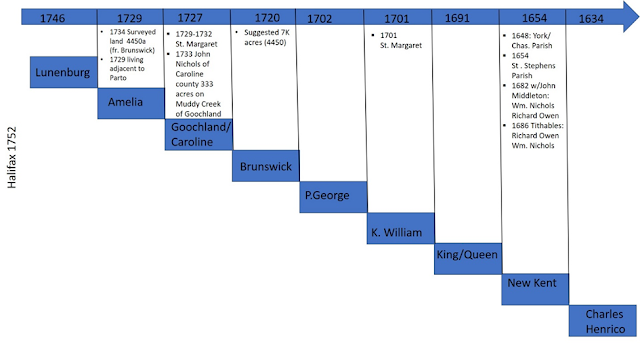
Virginia and the Carolina Colonial Map

Parish & Vestry Research Tips
Researchers must be cleaver when researching in colonial Virginia and the Carolinas. Recently the a3Genealogy research team was asked “Where do we start to unearth early Virginia settlers? 

We’ve touched on this topic many times, but to recap be sure to review Researching Colonial Virginia, North Carolina, and South Carolina: Why Can’t I Find MyRecords. Here we talked about timelines and county formations; but we didn’t share Parish Research tips and hints. I must say Parish Research is vital to your success!

Starting with our project formation map, which we individualize for our clients based on their ancestral settlers, we scour one county at a time.  In the example above we located our Nichols in Halifax in abt 1752 using wills, probates and land deeds.  So, to find the ancestors of this subject, we turn next to Lunenburg County, VA. Sure, these ancestors could have migrated from some other location, but we needed a starting point; and Lunenburg County, VA proved to be a good one that led us back to 1654, New Kent County, VA.

Parish Record Research
Parish / Church Records trump census records for our research team!  We are always “nose-first” in parish and church records.

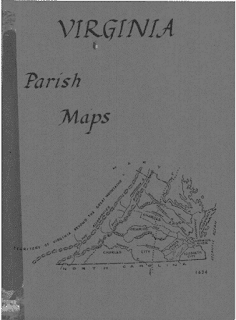
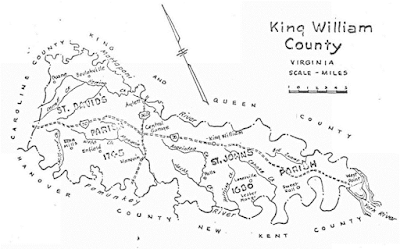
Begin with The Virginia Parish Maps. This resource alphabetized by counties can be viewed online at Virginia parish maps (familysearch.org). Your biggest clue may not be from the parishes outlined inside the County, but may also be from the quick-glance at the names of surrounding counties,  Be sure to take note of them.

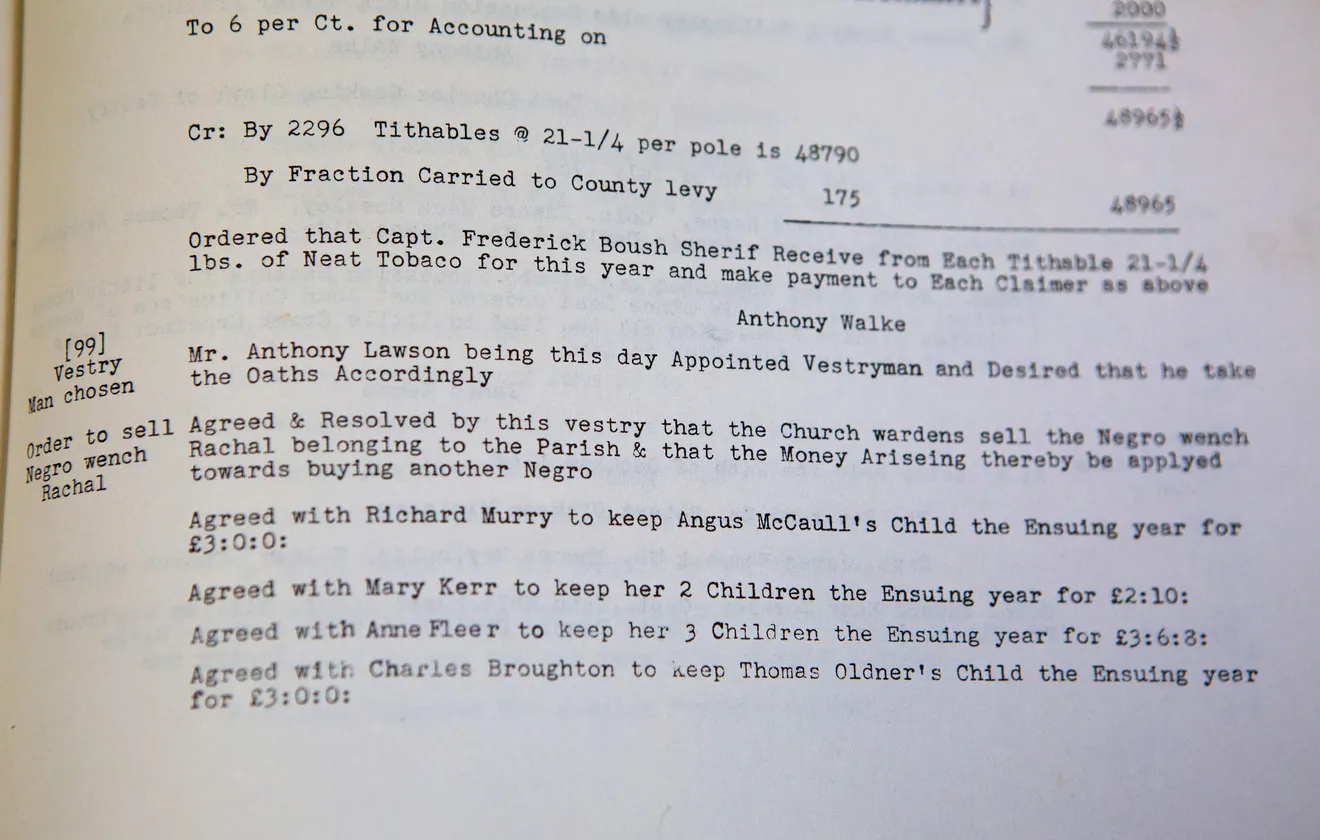
Luckily, Familysearch.org has a great selection of parish and vestry books. Vestry book or road maintenance books may be your only notice of early ancestors.Works may also be found with a simple Google Books, Jstor and WorldCat, as well as State Libraries and Historical Societies.


Know that White parishioner records began as early as 1631; African American, as well as Native Americans’ vital statistics were maintained beginning abt. 1672.  
All male persons of the age of sixteen years or upwards, and also negro, mulatto, and indian women of like age ("except tributary Indians to this government," were "tithable" or chargeable for county and parish levies. But the Court or Vestry "for reasons in charity," could excuse indigent persons from payment, and this was frequently done.
Colonial Vestry Book
Lynhnhaven parish, Princess Anne County, VA, 1723 - 1786

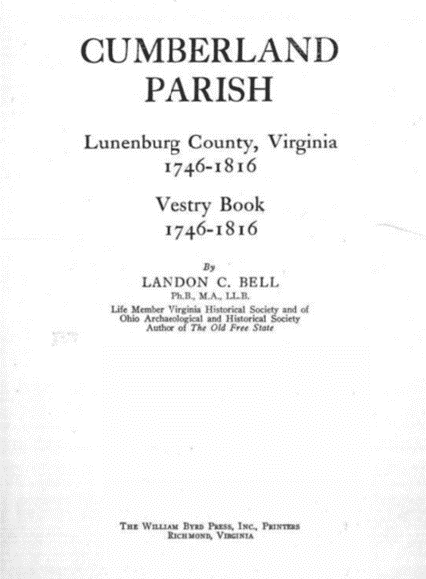
The key to this research is to determine the extent of the original parish, timelines, and names of the parish's subdivisions. Below you can see how Cumberland Parish, 1746 was divided up to form many parishes by 1778.

Cumberland Parish, Landon C. Bell

Along with Colonial Parish Records, we also suggest scouring the Anglican Church and Government Records in England. 

Other Resources
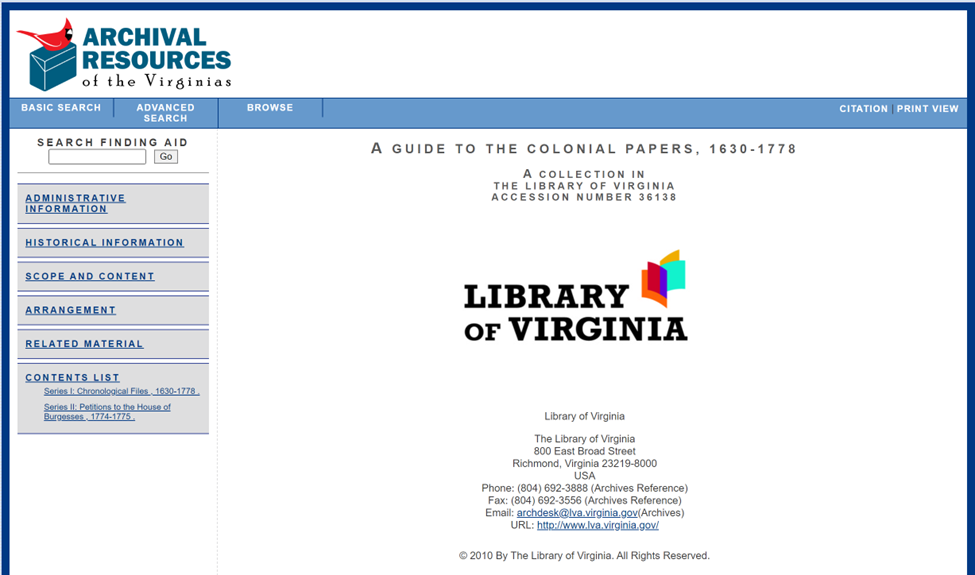
The Library of Virginia holds a wealth of documents and material on Colonial Virginia (and a few other colonial settlements.  Be sure to visit their Archival Resources: A Guide to the Colonial Papers, 1630-1778 Colonial Papers 36138 (virginia.edu)


Be Historically Correct

Kathleen Brandt
a3genealogy.com
Accurate Accessible Answers
a3genealogy@gmail.com


Wednesday, August 3, 2022

Oh My! Mississippi Records Are Hiding Ancestors

Image: Library of Congress

Where Are the Wills and Probate Proceedings?
Rarely is it that the obstacle to accessing ancestor's court records is "figuring out" the filing logic of the court recorder. Sure, we often have issues finding the correct collections, or court holdings, but once the records are in hand, we have indices, dates, page numbers from abstracts, or even loose papers that can be perused in order to lead us to our ancestors. Yet, a recent Hinds County research project in Jackson and Raymond Mississippi County Clerks’ Office 1800 court records initially led us down dead-ends. We had in hand the ancestry.com produced 1852 Will which named children, and the desired fate and distribution of slaves. However, the 1875 associated probate obviously made the 1852 slave filled Will mute. Plus, our Moseley acquired additional land up after the writing of his 1852 will. 

Neither Raymond nor Jackson District Court Clerks were successful in locating the probate supporting papers.  The a3Genealogy question was where were the court recording that support the  familysearch.org index?  

Probate Proceedings, beginning 8 Mar 1875

What the Probate might tell us?
Supporting documents were needed to uncover Inventories, Appraisals, Receipts needed to assess business dealings and associates. Plus Guardianship records were needed to analyze kinship and familiar relationships as well as land ownership or land bequeathed to children and family. Probates are filled with hints of community associates through witnesses, testimonies and affidavits. Yes, there are abstracts, but they are incomplete and often misleading.  This comprehensive research required access to original records, or at minimum copies of the full records. 

Tips and Hints to Uncovering Court Records

Step 1: Learn the court systems for the era and place of your ancestor. This may require engaging court recorders.  Mississippi utilizes Chancery Courts. Hinds County has two relevant Chancery District Courts: Raymond, MS -District 2 (the historically older) and Jackson MS - District 1, a significantly larger archival collection. 
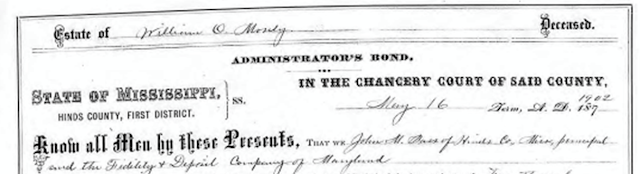
"Mississippi, U.S., Wills and Probate Records, 1780-1982," 1902; Ancestry.com


Know that there are selected court record images on ancestry.com. They too are vital, but lack the full details of the Chancery Court proceedings.

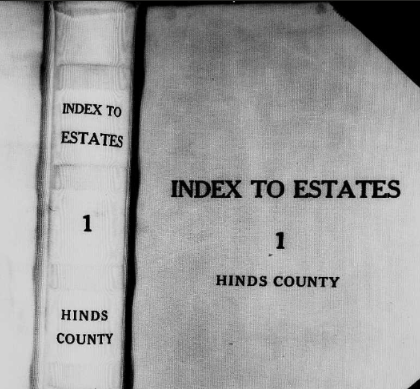
Step 2: Understand the Index to Estates? I'm sure, not unique to Mississippi, but the Index to Estates, initially appeared senseless. 

The a3Genealogy team turned to FamilySearch.org  digitized records for Hinds County, MS: Index to Estates, Mississippi Probate Records, 1781 - 1930 for Hinds County, Chancery records. Undertaking a page by page search, eighty images in, we found our subject #131.  (See above Index image).

What type of numbering system was this?  Number 71 was followed by 112, followed by 131, followed by #141 on image 80. Although the numbering system appears random, the dates are sequential. 
Forgive us for thinking the #131 was either a page reference or sequential case reference.  Clearly this was neither a sequential numbering system by cases, or page numbers.  

It was discovered that #131 was the key to finding our Moseley subject and the research needed within the Chancery Records. Yes, the person's case file is given a number, and the researcher must for the occurrences of that case number. The key is to 1) find the first occurrence of your subject which will require a page by page search since these earlier pages are not number; and 2) follow their personal case file number by jumping to the next date proffered by the the index.

Step 3: Create an At-A-Glance Timeline. This research is not for the weak at heart. There's no easy way as page numbers are nonexistent and these books are not arranged alphabetically by last name (or otherwise).  By using the index (above with dates) we suggest researchers create an At-A-Glance timeline.  Who wants to decipher or repeatedly reference these scribbles? 

The index for #131 was lengthy, but a timeline will save hours wasted. Here is a sample of ours (nothing fancy) using the dated information provided by the index:

  •   8 May 1875    Will filed and ordered probated 
  •  28 May 1875  Pet. Filed with will 
  •  29 May 1875   Pet for letters filed 
  •  31 May 1875   Letters Granted , [&] warrant of appraisement same day
  •  4 and 8 Nov 1875    Order to sell per. property made 4 and 8 Nov 1875
  • 2 Feb 1876    Order to sell personal property 
  • 4 Oct 1876     Motion for Guardian Ad Litem & Conservator Filed 

Step 4: Follow your subject using the case number and the dates in you case number.

Remember, at this point you are just looking for your case number. For us, that number was #131. This was a case that continued until the early 1900's. So, not surprising when the 3rd Administrator was identified in 1879 on image #489 of 676 in 1878.  

March, 1878, Image 489

Family names, kinships, spouses and maiden names were given as expected.  Of course deaths were noted, and changes in the administrators were provided with details (deceased, ill, etc).  But, for this case one learns a lot about pre-Civil war and the Reconstruction Era of Hinds County, MS. 

Basically, we learned more than we bargained for and the client was slack jawed with surprise and wonder.  As we have client's permission, we will share more of the case in an upcoming blog post. 

For more about researching in Mississippi be sure to review Researching in Mississippi: Mississippi Gulf Coast.

[1] "Mississippi Probate Records, 1781-1930," William O. Moseley, Hinds Estate index 1872-1884, May 1875, Image 80;  FamilySearch, viewed 9 Jul 2021 (click link). 

Kathleen Brandt

Be Historically Correct
a3genealogy.com
Accurate Accessible Answers
a3genealogy@gmail.com