Friday, February 24, 2023

Using DNA to Unscramble Biological Family


Using DNA to Unscramble Biological Family
If you listened to podcast episode (#4), Adoption, Door-Knocking, DNA & (Family) Reunions, you learned that Charlotte used her adoption paper to uncover the neighborhood of her biological parents.  No names were provided to her in advance, but the tight community neighborhood, of course knew all the gossip.  So, she began knocking on doors, you will recall. 

She also connected with a  DNA first cousin, "Jimmy. His story is entwined and they joined forces on this journey. Charlotte knocking on doors, he, suppor"ting her!

Kathleen offered tips for Charlotte to have closure to her genealogical question: Is my first cousin, "Jimmy" related to me through both my mother and my father? Truly, Charlotte and first cousin, Jimmy, also an adoptee, were able to identify how they were first cousins on their maternal side. But, the question as to how Charlotte's paternal 2nd to third cousins were Jimmy's 4th -5th cousins remained. Even John wanted to know! How is this possible?

Untangling Unknown Biological Family
Kathleen offered Charlotte tips. Of course this applies to all who are looking for biological families (adopted or not): 
Step 1: Analyze ethnicity and haplogroups. In this case begin with Jimmy's Y-DNA test results.
Step 2: Familiarize and Understand DNA shared centimorgan expectations.  Reminder, it's not set in stone, but using the online tool, of thegeneticgenealogists.com, Blaine Bettinger,  DNA painter, you are able to eliminate the less than plausible relationships. 

Step 3: Obtain original birth certificates, if able, from state. 
Step 4: Access a copy of  Jimmy's father's birth certificate if possible.  Don't forget church records. 
Step 5: .  Identify the DNA cousin matches that may assist in pinpointing Jimmies grandmother's family line. You will want to understand a) triangulation b) shared chromosomes. It looks more daunting than it is. 

Step 6: Flesh out family trees to uncover your great grandparents trees and the grandparents and ancestors of Jimmy. You may have to build out other family trees also.

Kathleen Brandt
Be Historically Correct

a3genealogy.com
Accurate Accessible Answers
a3genealogy@gmail.com


Saturday, February 18, 2023

My Veteran: National Guard or Army / Navy Reserve: How to Research?


President Day 
Did you know 31 of the 46 American Presidents served in the Military? Many served in the state militia. Those records are held at the state level so researchers will want to reach out to their State Archives or Secretary of State archival records. 

Few of our American presidents served in the National Guard, or Army Reserve. Although like Millard Fillmore, the 13th U.S. President, born in 1800, served in units that melded into the National Guard or Army Reserve. Too old to fight, but seasoned enough, Fillmore commanded the Buffalo (NY) Union Continentals, a "corps of male home guards" over the age of 45. Did your ancestors join Fillmore's efforts in the Civil War? 

Perhaps your ancestor, like the following Presidents served in the National Guard: 
George W. Bush, Texas Air National Guard. 

President Truman served in both the Missouri National Guard and received his commission as a Major in the Officers’ Reserve Corps (1920), Colonel: Field Artillery Reserve (1953). 

Or did your ancestor served in the US Reserve, as did the following U. S. Presidents?
  1. Harry S. Truman, Colonel, US Army Reserve
  2. John F. Kennedy, Lieutenant, US Navy Reserve
  3. Lyndon B. Johnson, Commander, US Navy Reserve
  4. Richard Nixon, Commander, US Navy Reserve
  5. Gerald Ford, Lieutenant Commander, US Navy Reserve
  6. Ronald Reagan, Captain, US Navy Reserve
  7. George H. Bush, Lieutenant, US Navy Reserve
Finding your veteran's US Navy/Army Reserve and National Guard records, starts with understanding the history of both. 


Where Are the Records?
Learning the record group and it's history, can help the family historian uncover their ancestors' national guard and army reserve records.

The Army National Guard was established 13 Dec 1636.  The oldest Army National Guard was established in Massachusetts from militia regiments. The Massachusetts Army National Guard. 

As you already know, the National Archives - St Louis, commonly referred to as the National Personnel Record Center (NPRC) houses the records of our  ancestors called into active Federal military service post Civil War.  It is here that you will use the SF-180 form to uncover your veteran's active Federal military service.

However, if they were not called into active Federal military service, your veterans' records are held at the State level.  Each state has an Adjutant General. These state records include both the Army and Air National Guard units not on active duty. 

For these state records, we suggest starting with the State Historical Society or Secretary of State websites. Following are both examples: 

Kansas National Guard Records

We have found it best to just use a search engine for "adjutant general" plus the state in your search bar. Many will be listed on the Secretary of State website or a State Historical: 

Missouri State Guard Records by Unit, 1812 -  WWI

New Jersey is an example where early guard units merged with state's militia. Again, these records, with the finding aids, are mentioned on the NJ State Department. 
New Jersey National Guard records

If all else fails, contact the Adjutant Generals' office. They can guide researchers to the archived records.   

The Army Reserve began 23 Apr 1908 under the Congress' named auspices Medical Reserve Corps. These records are held in St. Louis.  Like other military records, use the SF180 form to obtain copies of your veteran's Army Reserve records.

The New York Times, New York, New York, 30 Nov 1908, newspapers.com

Here is a quick synopsis of the historical formation of present-day  Army Reserve. 

Initially, in 1908 Congress created the Medical Reserve Corps, the official predecessor of the Army Reserve. Subsequently, using its constitutional authority to “raise and support armies,” through the National Defense Act of 1916 and the sweeping changes to that law in the National Defense Act Amendments of 1920, the federal government created the Organized Reserve. Redesignated as the Organized Reserve Corps in 1948, the new force served into the 1950s to provide a peacetime pool of trained reserve officers and enlisted men for use in war. This manpower reserve existed as the officer cadre for as many as 27 reserve infantry divisions and 6 reserve cavalry divisions located across the nation. It also included the Officers’ Reserve Corps, Enlisted Reserve Corps, and Reserve Officers’ Training Corps. (Army Reserve: A Concise History)

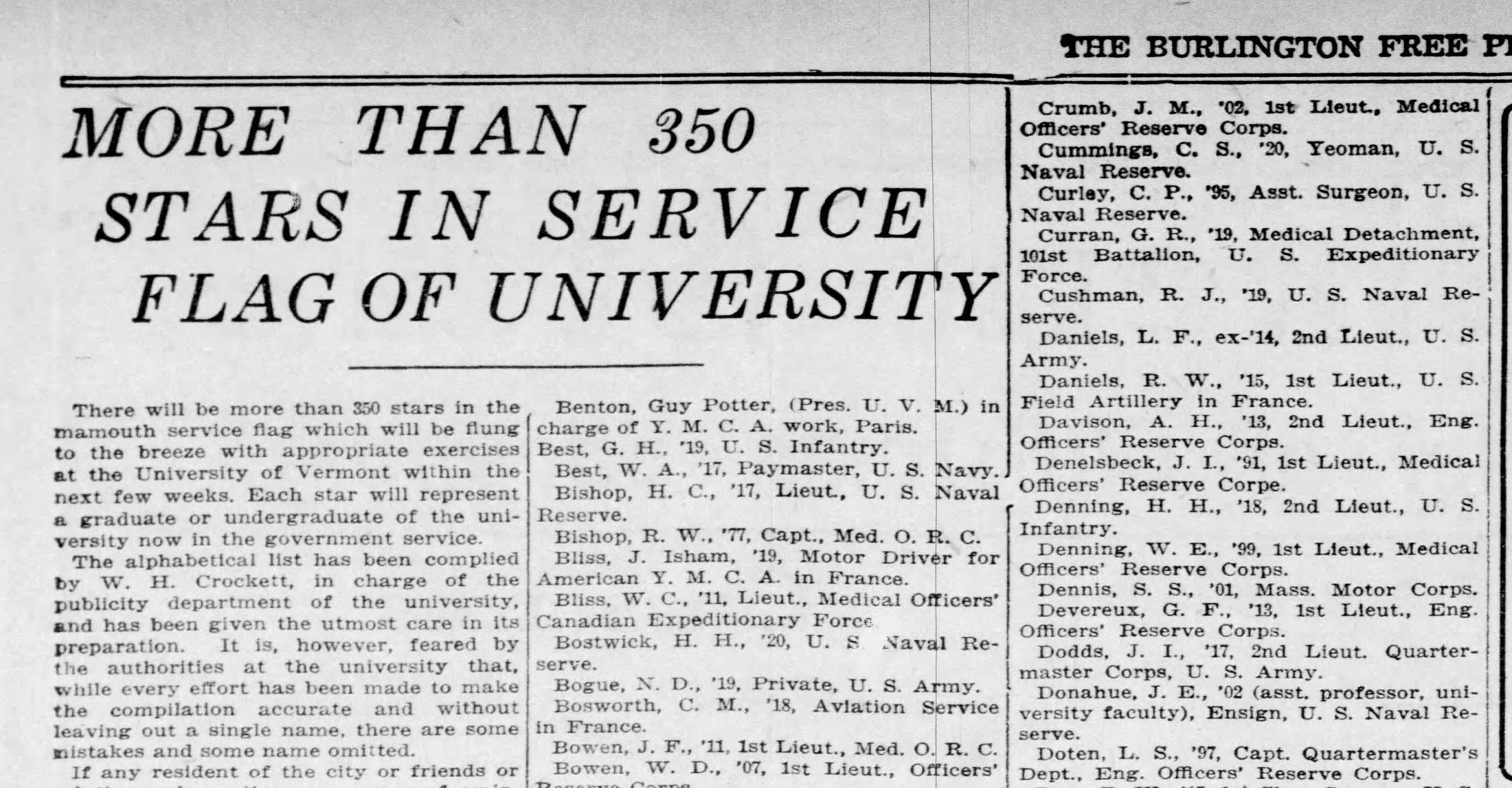
We know the Medical Reserve Corps (MRC) presently are state -driven community based units. This is NOT the federal Organized Reserve Corps. However, the Medical Reserve Corps was a highly touted service organization.  Be sure to search the local newspapers for your ancestors' name. 

       The Burlington (VT) Free Press, 15 Dec 1917, pg 11

Looking for a More Robust History of the Army Reserve? 
Visit the US Army Reserve Official Website

Other Resources

Army Reserve: A Concise History

I Am the Guard: A History of the Army National Guard, 1636-2000

National Guard

Kathleen Brandt
Be Historically Correct
a3genealogy.com
Accurate Accessible Answers
a3genealogy@gmail.com

Tuesday, February 14, 2023

Confederate Hospital Records: Defy the Myths

Reveal Confederate Ancestors Though Hospital Records
Don't believe the Hype, you can find confederate records of white and black ancestors, Free and the Enslaved. Matter of fact, they are quite revealing. If we turn to Confederate hospital records, they reveal where your confederate served, they offer duties and payroll for those in the war efforts. In addition to proving one's loyalty to the Confederacy, these records also proffer information on slaveholders, as well as slaves and free-coloreds, as these records provided a financial account. 

Record Group 109, War Department Collection of Confederate Records holds the captured or surrendered “Rebel Archives, ”but it’s the Records of (Confederate) Hospitals, RG 109.8.4, that provides additional information on our individual ancestors that served the Confederacy.

Griffin Ga, 12 Jul 1864
The Confederate Congress passed the “Act to better provide for the sick and wounded of the Army in Hospitals” on 27 September 1862. However hospital records are dated as early as 1861: Record Group 109.8.4, Records of (Confederate) Hospitals. Although not complete, you may find your Confederate ancestor listed or named correspondence and documentations included in the Records of the Medical Department, Confederate War Departments, 1861-1865.

If your ancestor was hospitalized in the Richmond Virginia area, there were many beds. The records of each of the area hospitals should be checked but the Chimborazo Hospital in Richmond, VA was the largest, with an 8000 patient capacity; and Winder Hospital, with a capacity of 5000 patients, also in Richmond.


If you find your ancestor in a nearby Confederate Cemetery, be sure to check the records of the closest hospital. For example: the Shelby Springs Confederate Cemetery listings has 105 graves listed on Find A Grave, many of the veterans interred here were patients at the Shelby Springs Confederate Hospital.

What to Expect
Besides listings of patients, and officers, the researcher may also find their Civil War Confederate veteran in the collection of hospital musters, lists of medical officers, lists of patients, soldier discharges, and more in Record Group 109.8.1 and Record Group 109.8.2. A bonus, should it be located, is the “Soldier’s Furlough Passes.” These records can be located in RG 109.8.2 Records of Medical Directors. Again, not complete, but the passes provide the dates of when a solder was furloughed from the hospital and furlough information directed to the soldier.

African American Confederate Ancestors
Unlike the 1840 and 1850 Slave Schedules, these records named slaves with their specific slaveholders due to the fact that any working slave gained financial gain for slaveholders through their war-work contributions.  
As for vocabulary on these records, know that muster rolls were personnel lists and records to include the wage amounts.
Named enslaved laborers worked at Ashley Ferry Nitro Works in South Carolina.
(National Archives Identifier 121637367)

Fold3: Confederate African American, Civil War

There are few records that record the Black men that serviced the Confederate military. However, the
 collection of medical records gives an account of African Americans that served in a medical facility as a civilian employee. Civilian employees may have been cooks, laundresses, etc. The recording of black Civilian workers varied between medical facilities. 

Know that not all hospitals recorded their black civilians or slaves. However, if available the African American records can be found in the hospital muster and clothing rolls, 1861-1865, RG 109.8.1. Most of the muster lists provide the employee, the name of owner and the date of service, and type of service. Even slaves who were placed at medical facilities are listed, but only by first name. As usual, to conduct your slave research, a slave master must be known, but they are named on these records.

In Richmond hospitals there are five (5) Confederate volumes targeting the African American workers. These volumes are not indexed, but available:
  • List of colored employees, General Hospital No. 21, 1862-1863 (Vol. 14)
  • Lists of employees and accounts for food purchased, Chimborazo Hospital No. 1, 1862-1865 (Vol. 307)
  • Record book, Chimborazo Hospital No. 1, 1862-1865 (Vol. 310)
  • Lists of employees, Chimborazo Hospital No. 2, 1862-1865 (Vol. 85)
  • Jackson Hospital, lists of employees, Division Nos. 1-4, 1863-1864 (Vol. 187) Locations of Hospitals
CSA Hospitals
A listing of eleven Confederate States' assigned hospitals with salvaged records is below:
Alabama
Fort Morgan Hospital, 1862-64
Ross General Hospital (Mobile), 1861- 65
Shelby Springs General Hospital, 1864-65
Arkansas
Rock Hotel Hospital (Little Rock), 1862-63
Georgia
Walker General Hospital (Columbus), 1864-65
General Hospital No. 1 (Savannah), 1862-64
Additional hospitals at Dalton, 1862-63, and Macon, 1862-65
Kentucky
Bowling Green Hospital, KY, 1861-62
Louisiana
Shreveport General Hospital, LA, 1864-65
Mississippi
Lauderdale Springs General Hospital, 1862- 63,
Way and Yandell Hospitals (Meridian), 1865
St. Mary's Hospital (West Point), 1864-65
New Mexico
Fort Fillmore, 1861-62
Dona Anna, 1861-62
North Carolina
General Hospital No. 7, 1861-65
Pettigrew Hospital (Raleigh), 1861-65
Military Prison Hospital (Salisbury), 1864-65
General Hospitals No. 4 and 5 (Wilmington) 1862-65
Additional hospitals 1863-65
Charlotte, Fort Fisher, Goldsboro, Greensboro, and Wilson
Tennessee
Overton General Hospital, Memphis, TN, 1861-62
Texas
General Hospitals at Franklin and El Paso, TX, 1862, and Galveston and Houston, TX, 1861-65
Virginia


Chimborazo Hospital, 1861-65
General Hospitals No. 1-27, 1861-65
Howard's Grove Hospital, 1862-65
Jackson Hospital, 1861-65
Camp Winder General Hospital, 1861-65
Danville, 1862-65
Orange and Farmville, 1861-65
Petersburg, 1861-65
Williamsburg, 1861-64

Kathleen Brandt
Be Historically Correct
a3genealogy.com
Accurate Accessible Answers
a3genealogy@gmail.com
Original Post: 10 Feb 2013; Rewritten & Revised post 2 Oct 2023    


Wednesday, January 25, 2023

4 Tips to Tracing Ships: Mail , Slave, or Immigrant Ships


Question
: How do you determine where a  ship originated?  
The same basics apply on all ships:
mail ship: was your ancestor on a route
immigrant ship: the manifest proffers names. The names tells the story
indentured servant: where are the ship Captain's records. Newspapers offer quite a bit of background
slave ships: who paid passage and for what destination.

Remember the basics are the same. Let's use Anna's example of her ancestor on a slave ship. 
  1. Analyze and take Inventory or Information from Document
    - Slave Manifest. Gather slave name and approximate age with description: Moses, 38 years old, 6 feet, copper skin.
    - Ship information. ship name: SS Louisian, ship captain, date of transport, shipper.
  2. Research ship Capt. and and route

    W. H. Talbot, NOLA was a Captain of the SS Louisiana, a Texas U. S. Mail Line. Newspaper search will provide a lot of contemporary information on the Capt. and Steamship Louisiana. This Texas Mail line circled from Indianola Texas, to Galveston to New Orleans.
    Resource: Local Newspapers: Portal to Texas History
  3. Research the Shipper
    Be sure to note all names on ship manifests, but be very deliberate with all information on the shipper. Who is the person named on ship manifest, from where (may not be the same as the ship).
    Obituaries and Local News
    Resources: Newspapers, genealogy databases, county histories
  4. Understand the waterways. This will answer why this ship? Mississippi River from New Orleans to Louisiana, to the Pearl River of Mississippi.
    Resource: Take a tour to experience. Relavant to this Episode: consider the Pearl River Swamp Tour. Pearl River Swamp is not only known for runaway slaves, but you can learn how it impacted your confederate soldier.
    Operations of slave ship.
Keep in mind this article is written for Moses, the slave on the SS Louisiana. Therefore the resources provided are directly tied to Hittin' the Bricks with Kathleen: Ep: 02 Manifest, Ships and Camels! Oh My!
And the Camels?
(You have to listen to the Episode to understand this reference. 
Jump on board. I invite you!)
Remember Indianola TX. It was the on the stop between SS Louisiana mail route between New Orleans and Galveston. Well, did you know the U. S. Army transported camels through the port in Indianola, TX from 1856 to 1866. The US Army had a Camel Corps two shiploads of camels (total of camels landed at Indianola,Texas. The actual headquarters for the U.S. Army Camel Corps was in Camp Verde, AZ. Be sure to read: The sinister reason why camels were brought to the American West. National Geographic.

If you are interested in sharing your family brickwall with Hittin' the Bricks with Kathleen (HTB) be sure to complete the submission form here.

Kathleen Brandt
Be Historically Correct
a3genealogy.com
Accurate Accessible Answers
a3genealogy@gmail.com


Friday, January 20, 2023

2023 Added / Updated Genealogy Presentations


For Your Conference
Yes, most are now finalizing their 2nd and 3rd quarter 2023 conference schedules. Here are a few new titles with or updated cases and resources. Of course, be sure to look at our 2022 Speaker Series and earlier listing also. Remember, each presentation is tailored to your conference to align with your theme, and your needs.  

We don't recycle,
unless, of course, you ask for it!. 

I also do presentations for corporations, university/colleges, and private associations. These presentations are part of our MarketingYou Are a Pioneer Series that includes integrating genealogy, DNA, forensic genealogy and health. That's why I am the expert at customizing presentations for you and your organization (or family). Our recent clients have been bankers, heirship specialists, attorneys and shhhh....our favorite Napa Valley vintner. 

If you haven't heard...

I can directly tie genealogy to 

every facet of life!

 Research Methodology

  • The Changing Surname: How to Trace It
  • The Midwest Gateway to Genealogical Resources
  • 10 Tips to Crumble Brickwalls

 Why Did They Disappear

  • The Orphan Trains
  • The Orphanages, Insane Asylums, Mother Homes, and Poor Houses

 Immigrant Research

  • Midwest Ethnic Settlements: Tracing Your Immigrant Ancestor To and Through the Midwest
  • When They Came to America, Where Did they Go? The Midwest Migrants
  • Tracing your Midwest Immigrant Ancestor: From Emigration to Immigration

Military

  • Recreating Your Missing Military Files
  • Revolutionary War
  • War of 1812
  • Civil War Research
  • WWI and WWII
  • The Forgotten Military Treasures

 NARA

  • NARA and Our Ancestors (National Archives and Records Administration)

 Fun After Lunch

  • All I Want is a Photo!
  • All Newspapers Databases are NOT the Same: Get off newspapers.com
Let Kathleen and the a3Genealogy Team help you shape your conference. 
Just ask for your topic.  This is not a complete list, but our 2023 "New and Updated" list. 

Be Historically Correct

Kathleen Brandt

a3genealogy.com
Accurate Accessible Answers
a3genealogy@gmail.com

Tuesday, January 10, 2023

Listen to Podcast Ep:01 The Mystery of Cornelia Grey

When a Missouri Rhineland Folklore Stumps You
Join Kathleen with Angela Rodesky, from Delaware for Podcast Episode: 01 The Mystery of Cornelia Grey. 

Cornelia is from one of the eleven counties of the  Rhineland (German) region of Missouri: Cape Girardeau.  Listen here to the Hittin' the Bricks with Kathleen podcast Ep:01 and learn about the Missouri Rhineland region below. 

Counties of the Rhineland Region of Missouri

Plus, it's time to prove the family folklore, or bring down that brickwall! Yes, family folklore is just an ancestral distraction that our ancestors have perfected. 
 
Resources: 
Links Mentioned in this episode:
And don't forget: 
Be Historically Correct

Kathleen Brandt

a3genealogy.com
Accurate Accessible Answers
a3genealogy@gmail.com  
Thursday, January 5, 2023

Congress.Gov, The Forgotten Resource


Historical Context of Family History Month
As researchers we often reference contemporary newspapers to understand our ancestors' social history. We see phrases like "October, Family History Month," and we ignore the implications. Who declared it? What was the Need? When did it happen? Where (to include which citizensis the impact of this law? How is it to be impact my family in the future? 

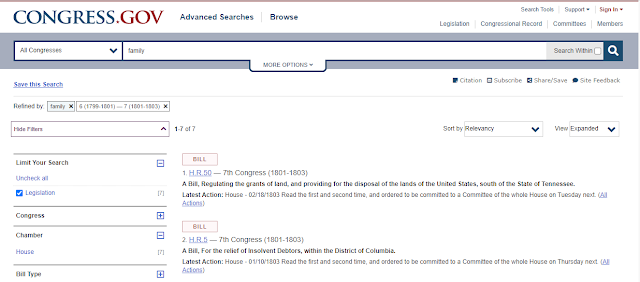
Most have never visited the congress.gov website, but its contents impacted our ancestors choices and struggles and successes.  Our ancestors migrated, settled and resettled as they fought for and voted for representatives to create laws that reflected their values and could determine their family's fate. So when October was dedicated to Family History Month we turned to the 107th Congress, congress.gov to understand how Family History Month became an October reality.

Purpose for this blogpost?
Our goal here is twofold:
  1. Encourage historical researchers, to include family historians, to peruse the congress.gov website to put laws and our ancestors into perspective. 
  2. To celebrate October as Family History Month 
Why use Congress.gov website?

The a3genealogy love for early territorial records led us to the congress.gov website as we researched the 1800, 6th Congress act for granting land to the inhabitants and settlers at Vincennes and the Illinois country, in the Territory North-West of the Ohio, and for conforming them in their possessions.''  Our brickwall was destroyed by understanding the law, beginning with 1800. Our client was looking for a full land trace a particular ancestor that led us directly to Vincennes. The ancestor died in 1837.

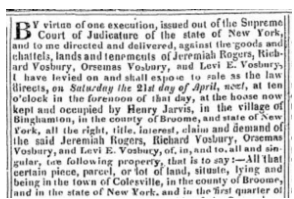
Of course, this was the same 6th Congress that established the system of Bankruptcy throughout the United States. Understanding this bill and its implementation and impact to our early Broome County, NY timber/lumber Dutch family, helped explained the descendants move to Portland, OR area.  
“trouble with lumber,” and greed from the Broome County Bank and their lawyers. “They sued me and father Vosbury, and Levi , and all my in dorsers [endorsers], and made costs upon costs till they broke me all up.”
But our first hurdle was to understand the impact of the law on these early Dutch settlers.

Congress.gov allows the family researcher to peruse all of the Bills, Acts & Laws from 1799 -present day. So when requested to provide historical research  on Family History Month celebrated in October, again we turned to congess.gov: S.Res.160 - A resolution designating the month of October 2001, as "Family History Month".  This historical research for the publication of an academic article.

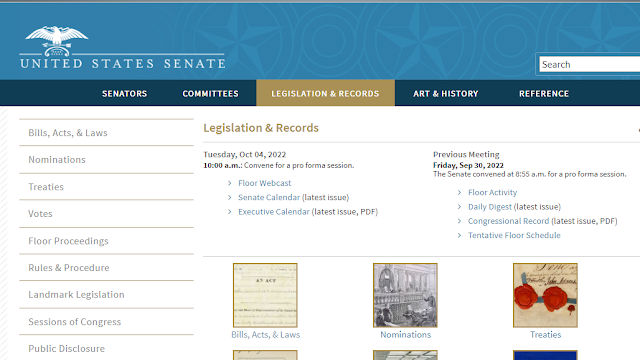
There are other government records for researchers to analyze. At a3Genealogy, we often turn to the Legislation & Records of the US Senate


What a wonder treasure trove these records are when working on our ancestors and understanding the national (and regional) influences of their choices. Plus, for us, in more cases than one, this understanding has led us to bringing down brickwalls. 

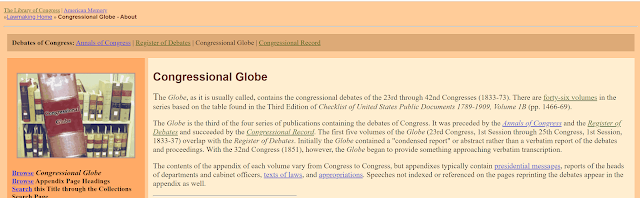
The 46 volumes of Congressional Globe contains the congressional debates of the 23rd through 42nd Congresses (1833-1873). 

Be Historically Correct

Kathleen Brandt
a3genealogy.com
Accurate Accessible Answers
a3genealogy@gmail.com