Thursday, February 28, 2013

Analyze Lands of Virginia and Kentucky

Virginians Granted Kentucky Land
Have you ever analyzed your Kentucky ancestors? If you get back far enough, you will find that many came from Virginia. Did you know that Kentucky was part of the Virginia Commonwealth? By following wars and the laws, you may be led to your early Virginian and Kentucky ancestors.

Looking at early Kentucky maps, it becomes apparent that south of the Green River is consistently designated as reserved territory. This is really obvious when researching the Mammoth Cave area in south central Kentucky, which is now a National Park, but at one point this massive set-aside land was the home of about 13 or more churches, residences and many cemeteries (few still remaining). Our research of this Mammoth Caves National Park and a few targeted early residents carried us back to the Revolutionary War and the French and Indian War. Yet Kentucky did not become a state until 1792.

War Impact
An often forgotten war in our genealogy research is the French and Indian War, 1754-1763. Perhaps you haven’t traced that far back yet, but it will probably prove to be significant in your Kentucky ancestors’ research. This war between British American and New France colonies left a paper trail since Virginia soldiers’ were awarded land grants in lieu of pay; leaving the researcher a wonderful collection of early Virginia-Kentucky ancestors’ land records. (The same is for Virginia-Ohio ancestors).

What are Bounty Land Warrants?
Our early military-active ancestors were enticed to join war efforts by the promise of “bounty land warrants.” Soldiers were able to first apply for the coveted warrants. If granted, the warrants on file confirmed the soldier and the number of bounty land acres he was entitled to based on his rank and other useful genealogical data is provided. 

Bounty land acres were reserved specifically for the purpose to pay for military service. For Virginia militia, land was set-aside in “Kentucky” for the soldiers (or heirs) to claim. Between about 1773 - 1792, Virginia soldiers, or their heirs, received warrants for bounty land. The land was located in what is Kentucky today. After the Revolutionary War, Kentucky was formed and designated from Virginia. Virginia Revolutionary War soldiers were also offered bounty land in Kentucky and Ohio. At least 4748 bounty land warrants were issued by Virginia to Revolutionary War veterans. The warrants authorized surveys of the soldiers’ land. A soldier was able to surrender his bounty land warrant for a land patent, resulting in ownership of the land.

Where are the Records?
The original warrants are held at the Kentucky Land Office, in Frankfort, KY and have been microfilmed by the Family History Library (FHL): Virginia Grants, 1782-1792. Be sure to also review the Old Kentucky Grants (1793-1856) microfilms held at the FHL. 

A vital resource to our Mammoth Caves area research was the FHL microfilm rolls of the Grants South of the Green River, 1797-1866. The land south of the Green river was also reserved for Virginia soldiers. 

Top research resources:
  1. Kentucky Land Office, Frankfort, KY 
  2. County Tax List,  held at Frankfort, KY also reference ancestry.com
  3. Preemption Receipts and Warrants from the VA Land Commission from the Library of Virginia, Richmond VA.  
  4. Kentucky Land Office Online Database: Virginia and Old Kentucky Patent Series 
For More Information
The process of Warrants to Patents has been simplified in this article. Much deeper understanding of the law is necessary for a successful search. Here are two places to begin:
Kathleen Brandt
Website: a3genealogy.com
a3genealogy@gmail.com
Accurate Accessible Data

Sunday, February 10, 2013

Confederate Records for Free, Slave, White and Black

Confederate: Chimborazo Hospital, Richmond VA
Confederate Hospital Records
Many Confederate records were destroyed, often on purpose, so when we discover a useful resource for genealogical research of Confederate ancestors, we do a happy dance. Record Group 109, War Department Collection of Confederate Records holds the captured or surrendered “Rebel Archives, ”but it’s the Records of (Confederate) Hospitals, RG 109.8.4, that provides additional information on our individual ancestors that served the Confederacy.

A Good Place To Start
The Confederate Congress passed the “Act to better provide for the sick and wounded of the Army in Hospitals” on 27 September 1862.  However hospital records are dated as early as 1861: Record Group 109.8.4, Records of (Confederate) Hospitals.  Although not complete, you may find your Confederate ancestor listed or named correspondence and documentations included in the Records of the Medical Department, Confederate War Departments, 1861-1865.
  
If your ancestor was hospitalized in the Richmond Virginia area, there were many beds. The records of each of the area hospitals should be checked but the Chimborazo Hospital  in Richmond, VA was the largest, with an 8000 patient capacity; and Winder Hospital, with a capacity of 5000 patients, also in Richmond.

If you find your ancestor in a nearby Confederate Cemetery, be sure to check the records of the closest hospital. For example: the Shelby Springs Confederate Cemetery listings has 105 graves listed on Find A Grave, many of the veterans interred here were patients at the Shelby Springs Confederate Hospital.

What to Expect
Besides listings of patients, and officers, the researcher may also find their Civil War Confederate veteran in the collection of hospital musters, lists of medical officers, lists of patients, soldier discharges, and more in Record Group 109.8.1 and Record Group 109.8.2. A bonus, should it be located, is the “Soldier’s Furlough Passes.” These records can be located in RG 109.8.2 Records of Medical Directors.  Again, not complete, but the passes provide the dates of when a solder was furloughed from the hospital and furlough information directed to the soldier.

As for vocabulary on these records, know that muster rolls were personnel lists and records to include the wage amounts.

African American Confederate Ancestors
There are few records that record the black that serviced the Confederate military. However, the collection of medical records gives an account of African Americans that served in a medical facility as a civilian employee. Civilian employees may have been cooks, laundresses, etc. The recording of black Civilian workers varied between medical facilities. Know that not all hospitals recorded their black civilians or slaves. However, if available the African American records can be found in the hospital muster and clothing rolls, 1861-1865, RG 109.8.1. Most of the muster lists provide the employee, the name of owner and the date of service, and type of service. Even slaves who were placed at medical facilities are listed, but only by first name. As usual, to conduct your slave research, a slave master must be known, but they are named on these records.

In Richmond hospitals there are five (5) Confederate volumes targeting the African American workers.  These volumes are not indexed, but available:
  • List of colored employees, General Hospital No. 21, 1862-1863 (Vol. 14)
  • Lists of employees and accounts for food purchased, Chimborazo Hospital No. 1, 1862-1865 (Vol. 307) 
  • Record book, Chimborazo Hospital No. 1, 1862-1865 (Vol. 310)
  • Lists of employees, Chimborazo Hospital No. 2, 1862-1865 (Vol. 85)  
  • Jackson Hospital, lists of employees, Division Nos. 1-4, 1863-1864 (Vol. 187) 
Locations of Hospitals
A listing of these Confederate States assigned hospitals with salvaged records is below.
Alabama
Fort Morgan Hospital, 1862-64
Ross General Hospital (Mobile), 1861- 65
Shelby Springs General Hospital, 1864-65
Arkansas
Rock Hotel Hospital (Little Rock), 1862-63
Georgia
Walker General Hospital (Columbus), 1864-65
General Hospital No. 1 (Savannah), 1862-64
Additional hospitals at Dalton, 1862-63, and Macon, 1862-65
Kentucky
Bowling Green Hospital, KY, 1861-62
Louisiana
            Shreveport General Hospital, LA, 1864-65
Mississippi
Lauderdale Springs General Hospital, 1862- 63,
Way and Yandell Hospitals (Meridian), 1865
St. Mary's Hospital (West Point), 1864-65
New Mexico
Fort Fillmore, 1861-62
Dona Anna, 1861-62
North Carolina
General Hospital No. 7, 1861-65
Pettigrew Hospital (Raleigh), 1861-65
Military Prison Hospital (Salisbury), 1864-65
General Hospitals No. 4 and 5 (Wilmington) 1862-65
Additional hospitals 1863-65
Charlotte, Fort Fisher, Goldsboro, Greensboro, and Wilson,
Tennessee
 Overton General Hospital, Memphis, TN, 1861-62; 
Texas
General Hospitals at Franklin and El Paso, TX, 1862, and Galveston and Houston, TX, 1861-65
Virginia
General Hospitals No. 1-27, 1861-65
Chimborazo Hospital, 1861-65
 Howard's Grove Hospital, 1862-65
Jackson Hospital, 1861-65
Camp Winder General Hospital, 1861-65
Danville, 1862-65
Orange and Farmville, 1861-65
Petersburg, 1861-65
Williamsburg, 1861-64

Kathleen Brandt
Accurate, accessible answers

Friday, February 1, 2013

Using U.S. Congressional Serial Set, Part II


Black History Month
Yes it’s black history month, but family researchers with slave ancestors or those descendant of slave masters must tap slave and free-colored records year round. Why? Because these collections hold our history; a great part of the US history. So, here’s the highlight on slave and free-colored research using the U.S. Congressional Serial Set.

Using Serial Set to Research Slaves and Slave Holders
The U.S. Congressional Serial Set, filled with genealogical tips, hints, and treasures, is not getting its fair share of attention by genealogists or other historical researchers. I can’t think of one reason why this free-resource is not being perused on a regular basis. It’s full of what we love – gossip, scandal, court cases and names of both supportive and vile neighbors. It covers topics on women, African Americans, Native Americans, students, soldiers, sailors, pensioners, landowners, and inventors. Is this not the genealogists’ dream?  And as already mentioned – it’s free (with a library card).

If you use the keyword  “slaves” there are 659 occurrences  Some of these documents give us social history and legal proceedings void of ancestors’ names and may be deemed less than helpful to the researcher. But, the collection also includes claims for slaves killed in the military – especially useful if you are stuck in the War of 1812 era, pension appeals, land disputes, and even emancipation information like that of  Jane Hall (above).
Emancipation Papers: Francis Hall and Others.
Maryland slave Jane Hall, born 1799 ran away from her master in 1820 and subsequently was manumitted (as were her heirs) by Alexander Claxton in 1821. (Francis Hall, 55th Congress, 1st Session, Senate, Rpt No. 123).
Pension: Richard Jackson 22 Jul 1890 
Many pensions were settled at the congressional level and the US Serial Set has detailed accounts of the requests, proposals and appeals.  Richard Jackson, a slave and teamster for the Union Army was shot, captured and imprisoned, attempted an escape, shot again. The account is pretty detailed, and it also gives his slave master’s name as Dr. Charles J. Manning. (Serial Set-ID:2815 House of Representatives, Report No 2784, 51st Congress, 1st Session).
Land: On the Application of a Cherokee Indian Woman to Sell a Reservation of Land Which Was Made to Her Husband, Who was Adjudged to be a Runaway Slave. 
 A difficult research project is the intermarrying of Native Americans and African Americans residing in the southeast. A report dated 8 Feb 1831 documents Sally Johnson, a citizen of the Cherokee Nation in Jackson County, Alabama married a runaway slave Peter Johnson. Peter was “reclaimed by his master.” The legality of selling of Peter’s 650 acres of reservation land was in question. (Serial Set: A3P033 Publ. land No. 892, 21st Congress, 2nd Session). 

Runaway Slave Names: Benjamin Oden; 7 April 1834. 
Slave Frederick ran away from his master, Benjamin Oden in Maryland,1814. He enlisted in the military as alias William Williams and died in 1815.  Military men were entitled to bounty land and the master wanted to claim the bounty land that would have been given to William Williams, as if he were a free man. This one report gave us the name of slave, freeman alias and master. (Serial Set-ID 262; Benjamin Oden, Rep No 392, 23rd Congress, 1st Session, House of Representative). 
Accessing the U.S. Congressional Serial Set
If you aren’t familiar with the Serial Set, be sure to read U.S. Congressional Serial Set for Genealogists, Part I. The Serial Set is an online resource available via your local library that subscribes to HeritageQuest Online; and, it’s accessible remotely using your home computer with a library card.

Kathleen Brandt
a3Genealogy.com
Accurate, Accessible Answers

President's Sale Flip-Pal Mobile Scanner

Scan Images... Anywhere... Anytime with the Flip-Pal Mobile Scanner! Buy Now


Promotion Expires 20 Feb 2013

Free Shipping on all orders of $160 or more in the continental USA! 
(Applies to standard USPS Priority Mail Service only. Does not apply to USPS Express Mail Service.)

Save $15 on the 
Flip-Pal mobile scanner + Deluxe Carry Case Bundle!
(Regular Price: $179.98, Sale Price: $164.98 + Free Shipping)

Save $20 on the Flip-Pal Mobile Scanner Rechargeable Bundle! 
This bundle includes the Flip-Pal mobile scanner, a Deluxe Flip-Pal mobile scanner Carry Case and an Eneloop AA 4 Pack with AC Charger. (Regular Price: $209.97, Sale Price: $189.97 + Free Shipping)

Save $30 on the Flip-Pal mobile scanner with Craft Edition 2.1 DVD and Deluxe Carry Case Bundle!
Regular Price: 229.98, Sale Price $199.98 + Free Shipping)

Save $40 on the Really Big Bundle. This bundle, the Genealogists Dream, includes Flip-Pal mobile scanner, a Deluxe Flip-Pal mobile scanner Carry Case, aFlip-Pal mobile scanner Sketch Kit, a Picture Keeper PK 8, an Eneloop AA 4 Pack with AC Charger, a Flip-Pal mobile scanner Cleaning Cloth and a Flip-Pal Window Protector Sheets 3-pack. (Regular Price: $288.93, Sale Price: $248.93)


New and Upgraded Products

You can now automatically backup the digital scans on your computer and put them in a safe place. Just insert the Picture Keeper into any USB port on your computer, click "Start Backup" and the Picture Keeper automatically finds and saves your pictures. That’s it! 

Flip-Pal mobile scanner with Digital Creativity Suite 3.0 DVD
This new DVD bundle comes with software that works on both PC and Mac computers. You can make professional-looking projects with Photoshop Elements 10.0, Logo Design Studio Pro and Corel Paint It!

The Sketch Kit now comes with three pens—two black and one red! You can annotate scans of their photos by adding dates, names, places and more.
   
The Flip-Pal is considered a flatbed scanner (in most repositories) and can be safely used with original documents. Perhaps this is why repositories that previously have not allowed scanners to be used in the past are now allowing the Flip-Pal Mobile Scanner.

Happy President's Day!
Kathleen Brandt
a3genealogy@gmail.com
Flip-Pal Affiliate: http://flip-pal.com/a3genealogy

Thursday, January 31, 2013

Press Release: Genealogy and Corporations

Corporate Services to Offer
a3Genealogy has been called on for museum research for clients in Japan and Germany; documentary research for British clients; research for TV and media; and, even to research for marketing blurb for our favorite Napa Valley vineyard.

Did you know politicians, museums, banks, courts, law firms, and  TV, movies/films all use genealogists?  And it doesn't stop there.  No longer is genealogy just for family historians.  Corporations seeking genealogy services is on the rise.

Consultant, Presenter, Writer
Popular corporate services include historical and genealogy research, consultant services, corporate presentations and keynote guest speakers, as well as expansive and detailed writing projects (articles, white papers, etc).

To share relevancy to corporate clients and think tanks we embed social history and share evolution of thought, technology, and trends.  We trace family trees, aide in heir research, and connect the past with the present for many VIP clients.  As genealogists we provide historical context and consultant services to the media.

Clients
a3Genealogy clients find us mostly by word of mouth and referrals.  But we have implemented  3 client profiles:
1) Individual - family research
2) Corporate research (consultant, presenter, writer)
3) Ancestry and Academics - Genealogy in the School project

Case Study - The Will of Wellington Burt
Wellington Burt, lumber baron who died in 1919, was really a mystery until this year. Ninety-two (92) years after his death, Burt's estate was divided between his 12 living heirs.  Two of these heirs were the 6th generation - great-great-great-granddaughters.  But his will, which specified his fortune to be shared by his heirs "21 years after the death of the last grandchild born in his lifetime" according to CBS News 9 May 2011, leaves a wonderful case study of how courts, law firms, banks and heirs might be able to use a genealogist. 

Heirs often want detailed history of their ancestor. Others may benefit from an accurate account of Wellington Burt's life and that of his 6 children (and their descendants).

Genealogist and Politicians
Politicians have historically known that their past and their ancestral histories are of public interest.  Records - ship manifest, census, land,  marriage. birth/death records, and county histories await to illuminate ancestral pasts. Genealogists are often called upon to check ancestral facts. 

Migratory studies of ancestors may include the settlement of towns. This is just one key to determine migration patterns whether Norwegian, Swedish, German, etc.  

City and State Agencies
Genealogist work with city and state agencies. We know when the government proffered land grants, and we can outline when Iowa was settled by counties and when new counties were created. Using social histories we offer reasons to not only why your ancestor might have chosen Iowa,  but we can analyze counties and settlements to support their choices. Sure, we don't know what they were thinking but we can pull weather and news from early newspapers, diaries and books to determine what they persevered.

Kathleen Brandt
a3Genealogy@gmail.com

Wednesday, January 30, 2013

Metes and Bounds Primer for Genealogists

…on a south branch of White Oak on the south south side as follows. Beginning at a pine thence So67W 140 poles to a branch to three pines thence So7Et 120 poles to a post…to the beginning Containing 100 acres more or less.
From the White Oak Tree
We believe DeedMapper website best gives the advantages of platting your ancestors' land:

  • Find the location of a particular plot by anchoring a group of neighboring plots against a stream. We then overlay it using a current Google Maps , but that’s for another blog.
  • Discover genealogical relationships by showing that person X sold a part of person Y's land. Plus land platting results may give you kinship hints.
  • Untangle people having the same name by analyzing their landholdings and transfers.
  • Create a map of original landholders in a region. Or at least a map of your family in the region.
  • Trace changes in parcel ownership over the years.
Ancestors’ Land ?
There are two very different types of land surveys conducted in the United States: (1) “metes and bounds” and (2) “grid” or “rectangular” surveys. Metes and bounds surveys trace land boundaries based on physical features of the land, such as trees, boulders, roads, and fences. The original 13 colonies plus Hawaii, Kentucky, Maine, Texas, Tennessee, Vermont, West Virginia, and parts of Ohio make up the 20+ states that use the metes and bounds land descriptions.  

Let’s Do Math - Metes
I know this metes and bounds measurement “thing” seems random, but it really isn’t. It’s all based on a standardized length of chain determined in 1620 by Edmund Gunter. (No we cannot shun him).

Metes refer to distance (as in feet and inches); bounds describes the direction in degrees of a compass. And the total distance is described in terms of chains (Gunter Chain).  The Gunter’s chain measures 66 feet in length. So all of the units of measurements - poles, rods, or perches – are divisions of the chain.  One rods, pole or perch equals  16.5feet (or 25 links) on a 66 foot Gunter's chain.  Four of them add up to a full 66’ chain. (4x16.5ft= 66ft).

So Gunter figured fields were measured in acres, which is 1 chain (or 4 rods) by one furlong (group of 10 chains). I know what you are thinking…why can’t an acre just be 11 chains?  Well it is, but I’m guessing in the 1600’s categorizing groups of chains was really important – thus a furlong is a group of 10 chains. Either way, the metes and bounds measure boundary lengths in rods, poles and perches instead of feet or meters.

…And Bounds
 
As already mentioned, bounds describes the direction in degrees of a compass. Just remember very few places run due north, south, east or west, and very few plots were wonderful squares, so in the metes and bounds system, the directional degrees of boundaries are important. For this reason the degree (i.e. N33W) should be noted.

Where to Begin
You could draft your map with a protractor and ruler, but software like DeedMapper offers a platting tool.  Even if you are using a platting/mapping program, like DeedMapper, you must be familiar with the terms and the survey. I suggest you transcribe what you have before entering it in any software.

Here are a few more vocabulary tips:
Corners. Your survey will always begin at a corner. It may be a corner at the big Oak tree, but still a corner. The idea is you should make your various turns and movements and end back at “that” corner. Seems insignificant, but the big Oak tree was later the center of a lawsuit (became kindling for a few bad neighbors) and the court case proved to be a treasure trove of family information and names.

Shared Lines/Boundaries. This is a genealogical treasure. We already know cluster research gives us hints to family units. So we want to know whose land our ancestors bordered. Sometimes this leads us to children, parents, female maiden names, etc.

Meanders. My ancestors loved streams and rivers. I know that because their surveys all meander along the French Broad River, or another waterway.  The key is up or down stream. Surveys may also “meander on a road.” Note: always access an old map this will assist with not only identifying the land, but the meandering pattern.

Kathleen Brandt
a3genealogy.com
Accurate, accessible answers

Thursday, January 24, 2013

American Railroads and Records

Amtrak River Runner, Missouri, 2013

As historians and genealogists it’s hard to ignore the importance of the railroads to our American history. Every time I board a train to commute between Kansas City to St. Louis, or leave Washington DC bound for Philadelphia or New York, I think of our ancestors who laid the tracks, sold land and “human property” to the railroads, made a fortune investing in railroads, and those who lost everything on a gamble.  The railroad led the Industrial Revolution - building bridges, new depot architecture and production of rail cars.  The expansion of the railroad post-Civil represented the faces of America with its immigrant and its ex-slave workforce. As you trace your ancestors from about 1830 through the Industrial Revolution, remember to follow the tracks. 

Finding Your Railroad Ancestor
“Follow the tracks” is not just a motto, it’s what our ancestors did. Men, and sometimes entire families and communities, left their home base for work. Skilled and unskilled labor (and skilled)  men were on the railroad labor rosters. This may have landed your ancestor in the next county, next state, or on the route of the Transcontinental Railroad. 

Practically every newspaper across America from San Francisco (Central Pacific) to Omaha Nebraska (Union Pacific) reported daily news of the Transcontinental Railroad.  Irish settlements lined the Union Pacific tracks, and many Chinese Americans worked on the Central Pacific. Railroads bought and sold slaves, and was the largest employer for ex-slaves after emancipation. These workers also lined regional and local railways.  

Where to Find Records
"I have known the slave Jerry"

Looking for Slave Ancestor?: It has been suggested that over ten thousand enslaved men, women, and children worked on southern railroads between 1857 and 1865. For documents/records be sure to review local railroad deeds, contracts and lawsuits. These records may list your ancestor by name as contractual labor.  Letters between slave traders and railroad company officers can be located in State Archives and Special Collections.

Irish Railroad Workers: When researching your immigrant ancestor if you follow the tracks, you will find not only railroad documents, but a bit of their day to day life. Be sure to map out the historical churches and cemeteries along the tracks and review the records. The B&O Railroad employed low paying Irish workers even before 1850 (the heyday of the railroad). And the nearby St. Peter the Apostle Church and Cemetery holds accompanying family data. Have you visited the Irish Railroad Workers Museum in Baltimore, MD?

What Other Records Are Available?

Railroad Retirement Board. Some of the records that hold valuable genealogical information are the
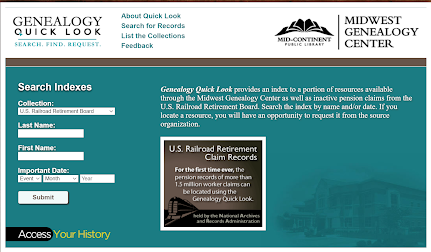
U. S. Railroad Retirement Board records (RRB) claim and pension files. A great index is on the Midwest Genealogy Center, U. S. Railroad Retirement Claim Records. These records document railroad workers’ claims after 1936. When researching for this timeframe, be sure to check both the RRB and the National Archives (NARA) Southwest Region Atlanta facility. 

State Archives and Museums. Family researchers may find in State Archives or area repositories additional railroad collections. Often these collections have information on sick, injured, deaths and dates of service. A favorite is the Pennsylvania Historical and Museum Commission -Pennsylvania Railroad Company. 

Unions and Rosters. Many railroad union membership records and rosters have been salvaged (early 1900’s), and may have been compiled and digitized for online viewing. The New York Central Railroad Seniority Roster provides names, dates of service and positions; whereas the larger Northwest Railroad Employees Rosters provide location details specifying the railroad line worked. 

Historical Society and Special Collections.  A great place to begin your railroad research is at the local Historical Society or public library and university’s special collections. The Indiana Historical Society is the repository for the Monon Railroad Collection (1851-1971).  From their website: 
"Material regarding Monon employees consists of engineer lists (1878-1923), pension lists (1930s-1970s), retirement dinner programs (1950-1963), fifty year pin lists (beginning 1943), and funeral bulletins (1960-1970s). A scrapbook contains newspaper articles (1947-1949)."
Know that many records have not been preserved or are in far-reaching archives. For example the Missouri Pacific Railway, operated from 1851-1997.  Their records are not held with the Missouri Pacific Historical Society but in the Hutchinson, KS salt mine storage facilities.

For More Information


Kathleen Brandt
Website: a3genealogy.com http://a3genealogy.com/#!/pageHome
Accurate, Accessible Answers